When people in Britain hear "Caribbean food", they picture jerk chicken, curry goat, rice and peas. That food is wonderful and it earned its place here. But it is Jamaican, and the Caribbean is not one island.
I am from Guadeloupe. We are French. We eat differently. In twenty-eight years of cooking in this country I have watched people discover that and be genuinely surprised, so here is the guide I wish had existed when I arrived.
What Guadeloupean food actually is
Guadeloupe is an overseas region of France in the eastern Caribbean. Not a colony, not independent — legally and administratively part of France, with the euro, French schools, and French bureaucracy. That fact shapes the food more than anything else.
What sits on the plate is Creole cooking, and it comes from four directions at once:
- French technique. We braise, we make roux, we build stocks and reductions. A Guadeloupean cook and a Burgundian cook would recognise each other's hands.
- African foundations. The one-pot cooking, the root vegetables, the way heat and starch are balanced — that came with enslaved people and it is the backbone of everything.
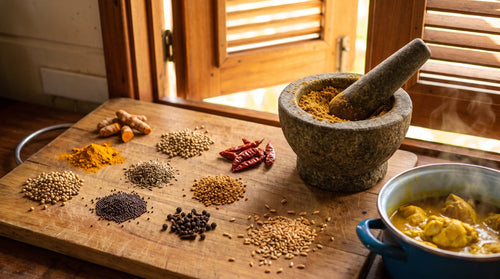
- Indian spice. After abolition, indentured labourers arrived from southern India. They brought the spice blend that became colombo, and it is now so completely ours that most people do not know it travelled.
- The islands themselves. Scotch bonnet, plantain, breadfruit, christophine, and the fish that were always here.
The result is not French food with chilli in it, and it is not Jamaican food in French. It is its own thing.
The dishes to know
Accras de morue
Salt cod fritters — small, lacy, crisp outside and soft in the middle. Every household makes them and every household believes theirs are correct. They are the first thing out of the kitchen at any gathering, and they never last. The recipe is here.
Colombo
Our curry, and the clearest evidence of that Indian arrival. Chicken, goat or pork, cooked down with the colombo spice blend, often with aubergine or potato. Warmer and rounder than a Jamaican curry, less sweet than a Thai one. If you only cook one Guadeloupean dish, make it this.
Court-bouillon
Not the French poaching liquid of the same name. Ours is a whole dish: fish simmered in a tomato and lime broth loud with garlic, thyme and scotch bonnet. Weeknight food, and the thing I make when I am homesick.
Bokit
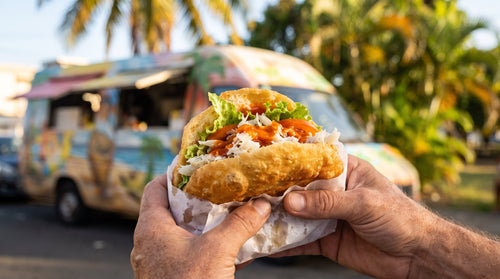
Fried bread, split and stuffed — salt cod, chicken, cheese, whatever you have. Guadeloupean street food, sold from roadside vans, eaten standing up. It is the one dish young Guadeloupeans abroad miss most, and there is still almost nowhere in Britain to buy one.
Sauce chien
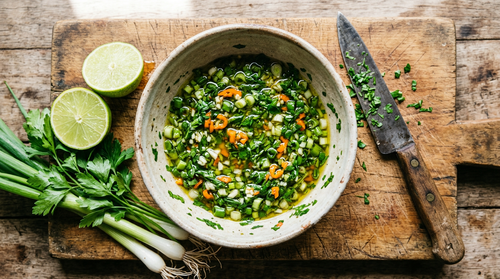
Literally "dog sauce", and nobody agrees why. It is not a cooked sauce — raw onion, garlic, parsley, spring onion and scotch bonnet, woken up with hot water and lime. It goes on grilled fish, on meat, on everything. Every family has a version and every version is the right one. More on that here.
Bananes pesées
Green plantain, fried, flattened, fried again. Crisp at the edge, soft in the middle, salted while hot. The method is here — the second fry is the part people skip and it is the part that matters.
Blaff
Fish poached in a sharp, aromatic broth with lime, garlic and chilli. The name is said to come from the sound the fish makes going into the pot. That may or may not be true, but it is what everyone says.
Why Britain never learned any of this
Numbers, mostly. Post-war migration to Britain came overwhelmingly from the anglophone Caribbean — Jamaica, Trinidad, Barbados, Guyana. Guadeloupeans and Martinicans who left mostly went to mainland France, because they were French and it was simpler.
So Britain built its Caribbean food culture from the islands that came here, and it built it beautifully. There was simply never a Guadeloupean community here large enough to open the restaurants, stock the shops, or make anybody learn the word colombo.
That is changing slowly, and it is most of why I do what I do.
Where to start
If you are cooking Guadeloupean food for the first time, do not start with the hardest thing. Start with accras if you want something people will fight over, or bananes pesées if you want a fifteen-minute win.
Then make a colombo on a Sunday, when you have the afternoon.
You will need scotch bonnet, thyme, garlic, lime and time. The first four are easy to buy now. The last one is the only genuinely difficult ingredient, and no shop sells it.
Everything else, I can help with. The sauces exist because I got tired of explaining and decided to bottle the explanation instead.