Slow-Cooked All Afternoon, The Way My Mother Made It
When I was a boy in Guadeloupe, oxtail was not a luxury. It was the cheap thing, the bony thing, the cut the butcher in Pointe-à-Pitre put aside because nobody with money wanted it. My mother wanted it. She would come home with a paper parcel under her arm, drop it in a bowl of cold water in the sink, and that was Sunday decided.
She had seven children to feed. She understood something I did not understand until much later: the cuts nobody wants are the cuts with the most in them. All that bone, all that gristle, all that stubbornness. Give it an afternoon and it turns into something no fillet steak can do. The gravy goes thick and glossy on its own, without flour, without anything. That is the bone giving itself to the pot.
I remember the smell most. She started it in the late morning and the house carried it until evening. Thyme, allspice, onion going soft. My brothers came into the kitchen every half hour asking if it was ready. It was never ready. She said the same thing every time, waving them out with a wooden spoon: it is ready when the meat lets go of the bone, and not one minute before you.
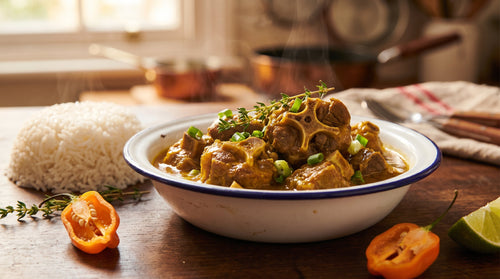
So that is what I will teach you today. Queue de boeuf, we call it back home. Browned properly, then left alone in a low pot with thyme, allspice and Caribbean Sauce Creole until it collapses. Butter beans at the end, because that is how my mother stretched it across seven plates.
Recipe at a glance
- Cuisine: French Caribbean (Guadeloupe)
- Prep: 25 minutes • Cook: 3 hours 30 minutes • Total: 3 hours 55 minutes
- Serves: 4 generously
- Featured sauce: Caribbean Sauce Creole
- Heat level: 5/10, warm and rounded rather than sharp
- Diet: Gluten free, dairy free
What you’ll need
Buy the oxtail thick if you can. Ask for the pieces from the wide end of the tail, not just the little tips, because the fat ones carry more meat and more gelatine. Most UK supermarkets sell it already cut into rounds. Two things matter more than anything else here: real thyme, and enough time.
You will notice the Sauce Creole goes in twice, some at the start with the seasoning and some later into the braise. That is deliberate, and I explain why further down.
For the oxtail and its seasoning
- 1.5kg oxtail, cut into rounds, trimmed of the loose outer fat
- 4 tbsp Caribbean Sauce Creole, divided
- 4 garlic cloves, crushed
- 3 spring onions, finely chopped
- 2 tsp fresh thyme leaves, or 4 sprigs left whole
- 1 tsp ground allspice
- 1 tbsp gluten free tamari or soy sauce
- 1 tsp fine salt
- Plenty of black pepper
For the pot
- 2 tbsp vegetable or rapeseed oil
- 1 tbsp dark brown sugar
- 2 medium onions, sliced thick
- 2 carrots, cut into chunky rounds
- 1 red pepper, cut into strips
- 2 tbsp tomato purée
- 800ml beef stock, hot (check the stock is gluten free)
- 2 bay leaves
- 1 whole scotch bonnet, left unpierced, optional
To finish
- 1 x 400g tin butter beans, drained and rinsed
- A handful of fresh parsley or coriander, chopped
- A squeeze of lime
How I make it
-
Season the meat first. Put the oxtail in a large bowl with 2 tbsp of the Sauce Creole, the garlic, spring onions, thyme, allspice, tamari, salt and pepper. Now use your hands. Really get in there, into the gaps around the bone. Cover and chill for at least an hour. Overnight is better. Half an hour on the counter will still do something.
-
Get the meat dry. Lift the pieces out and scrape the seasoning back into the bowl, keeping it for later. Pat the oxtail dry with kitchen paper. Wet meat steams. Dry meat browns. This is the whole difference between a grey stew and a dark one.
-
Make your caramel. Heat the oil in a big heavy casserole over a medium high heat. Sprinkle in the brown sugar and let it melt and go dark and bubbly. Watch it. You want it the colour of strong tea, not black. This is what we call the roussi back home, and it is where the deep colour of the gravy comes from.
-
Brown the oxtail. Lay the pieces in a few at a time and leave them alone for three or four minutes a side. Do not crowd the pot, do not keep turning them. You want a proper dark crust. About 12 minutes across two or three batches. Lift each onto a plate.
-
Soften the vegetables. Turn the heat down. Into the same pot go the onions, carrots and red pepper, along with the seasoning you scraped back into the bowl. Stir it around in all that dark stuff at the bottom for 6 to 8 minutes, until the onion goes soft and glossy. Add the tomato purée and let it cook out for another minute.
-
Bring it together. Return the oxtail and any juices from the plate. Add the remaining 2 tbsp of Sauce Creole, the bay leaves, and the hot stock. It should come almost to the top of the meat but not drown it. If you like real heat, drop in the whole scotch bonnet now and leave it unpierced.
-
Now you wait. Bring it to a gentle bubble, turn it right down, lid slightly ajar, and leave it 3 hours. Every 45 minutes lift the lid, stir, check nothing is catching. A splash of hot water if it looks tight. The oven at 150°C fan works just as well, same time.
-
Check the meat. Take a piece out and push it with a spoon. It should slide off the bone with no argument. If it argues, it is not ready: lid back on, another 30 minutes. Oxtail is never ready early.
-
Skim and reduce. Fish out the scotch bonnet if you used one, and the bay leaves. Tilt the pot and spoon off the fat that has risen to the top. Do not skip this. Then take the lid fully off and let it bubble for 15 minutes so the gravy tightens up and turns glossy.
-
Add the beans. Stir in the butter beans and warm them through for 3 or 4 minutes. Just warmed. If you boil them hard they break up and go to mush.
-
Finish and taste. Off the heat, a squeeze of lime and the chopped herbs. Taste it now. It will probably want more salt than you expect, because the meat has taken a lot of it. Add another spoon of Sauce Creole if you want it deeper.
-
Let it settle. Give it 10 minutes off the heat before you serve. The gravy thickens as it sits and the flavour comes together. This is the hardest part, I know.
The role of Caribbean Sauce Creole in this dish
A long braise is a hungry thing. Three and a half hours flattens out anything delicate, which is why fresh chilli on its own gets lost in a pot like this and you end up with heat and nothing behind it.
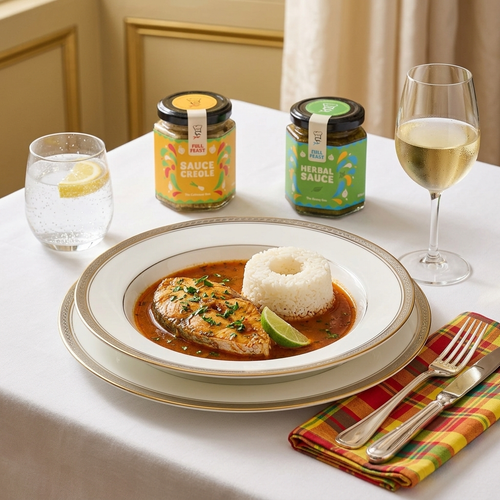
Caribbean Sauce Creole is built for exactly this. It is the rich, warming one, the traditional Guadeloupe Creole base, and here it does two jobs at two different moments.
The first 2 tbsp go on the raw meat. That is the seasoning layer. It works into the surface overnight and comes through in the crust when you brown it, so the flavour sits inside the meat, not on top of it.
The second 2 tbsp go into the liquid. That is the gravy layer: the onion and garlic depth, the thyme, the slow warmth that arrives at the back of your mouth two seconds after you swallow. Not a sharp heat. A rounded one, felt more in the chest than on the tongue. By the time it has reduced you cannot taste the sauce as a separate thing anymore. It has become the gravy, and that is exactly what should happen.
Tips from my kitchen
-
Trim the loose fat, keep the rest. Oxtail is fatty and that is what makes it good. Cut away only the thick pale flaps on the outside. The fat between meat and bone stays, and you skim what rises at the end.
-
Cook it the day before if you can. Oxtail is better on day two. Chill it overnight and the fat sets hard on top so you lift it off in one piece. Reheat gently. Best version of this dish you will make.
-
Do not add flour. People reach for it and they should not. The bones are full of gelatine and they thicken the gravy for you. If it is still thin, it just needs longer with the lid off.
-
The unpierced scotch bonnet trick. Whole, it perfumes the pot without releasing real fire. If it bursts you have a very different dinner. Take it out before serving so nobody eats it by accident.
-
Salt at the end. The liquid reduces by a third over three hours, so heavy seasoning at the start gets concentrated. Season lightly, correct it at the end.
What to serve it with
Rice and peas is the answer, and it is not a close contest. You want something plain and slightly sweet next to all that richness, and you want it to soak up the gravy. Plain long grain rice does the job too. Fried plantain on the side, cut on the angle and cooked until the edges go dark. Steamed greens or callaloo to cut through it.
On the table, put out Caribbean Hot Sauce for the ones who want more heat than the pot gives them. It is thick and bold and it sits well on the gravy. For a mixed table, a small bowl of Fresh Herbal Sauce gives the ones who take no heat something green and bright for their rice.
A cold beer. Nothing complicated.
FAQ
Why is my oxtail still tough?
Because it is not finished. That is nearly always the answer. Oxtail is full of connective tissue and needs three hours minimum at a low, gentle heat to break down into gelatine. If yours is chewy, do not turn the heat up, that only tightens it. Lid back on, another 30 to 45 minutes. I have never met a piece of oxtail that stayed tough forever.
How long does oxtail take to cook?
Three to three and a half hours in a heavy pot on the hob or in a low oven at 150°C fan. In a slow cooker, 8 hours on low, though you still need to brown the meat properly in a pan first or the whole thing tastes flat. In a pressure cooker, about 45 minutes at high pressure, and it works, but you lose some of the reduction so you will want to bubble the gravy down afterwards.
Why is my oxtail greasy?
Oxtail carries a lot of fat and some of it renders out into the gravy. Two fixes. Tilt the pot at the end and spoon the fat off the surface. Or, much easier, cook it a day ahead and chill it overnight so the fat sets hard on top and lifts off in a single piece with a spoon.
Can I make this without the butter beans?
Yes. They are there because my mother used them to stretch the pot across a big family, and because they are good at soaking up gravy. Leave them out and nothing breaks. Chickpeas or a tin of red kidney beans work in the same way if that is what is in the cupboard.
Is this recipe gluten free?
Yes, as written. All our sauces are gluten free and vegan, including Caribbean Sauce Creole. Just check two things on your own shelf: use tamari or a gluten free soy sauce, and check your beef stock, because some stock cubes carry wheat. Nothing else in the pot is a problem.
Final word from me
This is not a recipe you rush, and I would not want you to. Put it on in the early afternoon, do something else, let the house fill up with the smell of it. That is half of what makes it good.
My mother fed nine of us out of a pot like this on money that should not have stretched that far. She never once made it feel like we were eating cheap. If you make it properly, and you wait, you will understand what I mean.
Let it go until the meat lets go of the bone. Not one minute before.
JP