Creole food means different things depending on where you are standing. In New Orleans it means gumbo and shrimp étouffée. In Guadeloupe, where I am from, it means colombo, accras and court-bouillon. Both are called Creole, both are real, and they are not the same cuisine.
People in Britain mostly meet the Louisiana version first, through television and restaurant menus, and then assume that is the whole story. It is about a third of it. Here is what the word actually covers, and what the Caribbean side of it tastes like.
Where the word comes from
Creole comes from the Portuguese crioulo, by way of the Spanish criollo. It originally described a person born in the colonies rather than in Europe. Over time it stretched to cover the languages, the music and the food that grew up in those places — the things that were made there, out of what arrived from everywhere else.
That is the useful definition. Creole cooking is what happens when French technique, African foundations and local ingredients spend two hundred years in the same kitchen. It is not fusion. Fusion is a choice somebody makes. Creole is what a place becomes.
Louisiana Creole and Caribbean Creole: same roots, different tables
The two share a starting point — French colonial cooking, transformed by enslaved and then free African cooks, shaped by whatever grew nearby. After that they diverge.
Louisiana Creole is a city cuisine, from New Orleans. It leans on tomato, on roux cooked dark, on the "holy trinity" of onion, celery and green pepper. Cayenne for heat. Rice as the constant. It sits beside Cajun cooking, which is its rural cousin, and the two get confused for each other constantly.
Caribbean Creole — what we call cuisine créole in Guadeloupe and Martinique — is island cooking. Fish and seafood matter far more. The heat is scotch bonnet, not cayenne, and it is used whole as often as it is chopped. There is an Indian layer Louisiana never had, because indentured workers from southern India arrived after abolition and left us colombo. And there is a raw, bright, herb-and-lime sharpness running through everything that has no real equivalent in New Orleans.
If you put the two side by side, you would recognise them as relatives. You would not mistake one for the other.
What Caribbean Creole cooking is built on
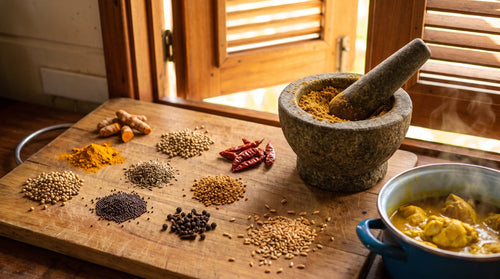
Almost every savoury dish starts from the same base, and once you know it you can taste it everywhere:
- Onion, garlic and spring onion — the foundation, always
- Thyme — fresh, in quantity. Not a pinch, a handful
- Scotch bonnet — for perfume as much as heat, often whole and fished out before serving
- Lime — the acid that keeps everything awake
- Allspice, clove, sometimes cinnamon — the warm spices that came with the trade routes
Get that base right and you are most of the way to the cuisine. It is the same reason a French cook can walk into a Guadeloupean kitchen and understand what is happening — the method is familiar — while the result tastes of somewhere else entirely.
The dishes that define it
Accras de morue. Salt cod fritters. The first thing served at every gathering and the last thing anybody stops eating. Recipe here.
Colombo. Our curry, from that Indian arrival. Chicken, goat or pork, warm rather than hot, and completely ours now.
Court-bouillon. Not the French poaching liquid — a whole dish of fish in a tomato, lime and chilli broth. Recipe here.
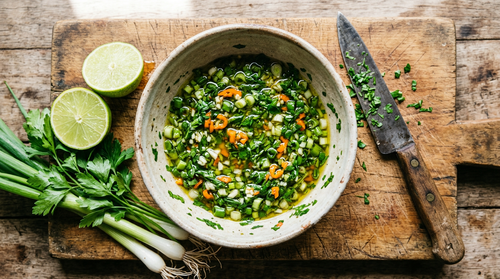
Sauce chien. The raw herb and chilli sauce that goes on grilled anything. Its story is here.
Bananes pesées. Twice-fried plantain, salted while hot. Recipe here.
Boudin créole. Blood sausage, spiced our way, sold hot from roadside stalls.
And rice. Always rice, usually with red beans cooked into it.
Why you have probably never eaten it
Britain's Caribbean food came with the people who came to Britain, and they came overwhelmingly from Jamaica, Trinidad, Barbados and Guyana. That is why jerk is a word everyone knows and colombo is not.
Guadeloupeans and Martinicans, being French, mostly went to Paris. So there was never a community here large enough to open the restaurants or fill the shelves. The cuisine is not obscure. It is just not here.
That is most of what I am trying to change. If you want to start, start with the guide to what we actually eat, and then cook one thing. The base is easy. The rest follows.